Tuesday, March 3, 2015

Hucking Triangles

Hucking Rules:

Rules are treacherous terrain.  In some people’s minds, Kennedy’s, rules cripple a player and prevents him from ever being able to play reflexively.  While other’s, Yngve, believe that Ultimate, like Jazz, cannot be improvised or taken solo without a strong understanding of the structure and the fundamentals of the game.  Rules are further complicated by a need to avoid “don’ts”.  In fact the only acceptable don’t, is don’t use don’t.

That aside, what ways do we have to quantify a good huck?  What rules do we have in place that we can point to and say, “see good job!”?

Thirds:

Same thirds is the only hucking rule I’ve ever heard of.  The concept is simple: take the field and divide it vertically into three thirds.  If you, your receiver, and the place you’re throwing too are all in the same third of the field then you did a bad job.  All other options are good.

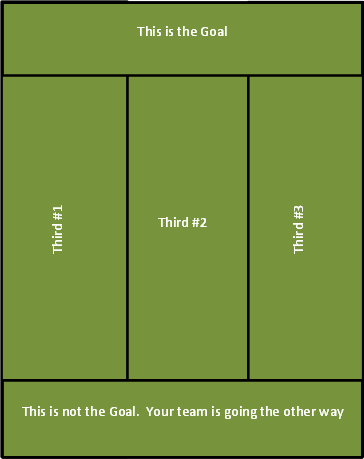
Simple enough, however people seem to screw this up a lot.  Below is a field.  On a completely unrelated note, I often wonder why it is so difficult to grasp the orientation of the field.  I hope I’ve outlined it completely below, if not imagine yourself inside the map.


Common misunderstandings:
1.      The thrower and the place the disc was caught are in the same third, that’s bad.
a.       False, there are three pieces not two.
2.      The thrower and the receiver were in the same third, that’s bad.
a.       False, there are three pieces not two.
3.      The receiver and the place the disc was caught are in the same third, that’s bad.
a.       False, there are three pieces not two.

Below is the same image as above with some dot’s on it:


T = Thrower
R = Receiver
C = Where the disc is caught

As you can see one of the two is not in the same third, therefore good huck.  Any drawing where three dots are in more than one third is a good huck. 

Below is the same drawing with new dots.


The three dots are all in the same third, bad huck.  “But Bruns does the endzone count?”  Yes.  Yes it counts.  Obviously the lines that split the field extend into the endzone, are you kidding me?

Triangles:

So far I’ve outline the rule of thirds.  It’s easy, clear, extremely accurate, yet somehow incredibly difficult to grasp and apply quickly.  The main issue people have with this rule is that they forget there are three pieces, not just two.

This is where my thought comes in.  It’s the exact same as the rule of thirds, I just hope it’s easier to think about.  I call it hucking triangles.  The main advantage I see in the hucking triangle rule is that it is more dynamic, ignore the field and just look at the three pieces, what kind of triangle does it make? 

Below is an image of a field.  Again I hope it is clearly drawn.


Below is the same field with dots on it.
 

Again:
T = Thrower
R = Receiver
C = Where the disc is caught


Now, I’m about to do something crazy.  Please brace yourself.


I have drawn a triangle.  A good triangle is one that has large surface area, the more surface area on a triangle the better


This is a bad hucking triangle, due to how little surface area it covers.  Terrible!

The Limits:


Just as with the rule of thirds, hucking triangles have limits.  The most obvious is that silly cutters will believe that they should make their cut from R to C in the straight line that is drawn on the field.  This is absolutely and comprehensively wrong.  The cutter will not follow a straight line from dot to do, he will probably run down the field as he makes a read and curve into the disc.  The point of the triangle is to connect where we are starting to where we end and summarizing, not to tell us how to get from here to there.

Monday, March 2, 2015

Creativity

This is a post of questions and experiments, certainly no answers will be found here.

How do you build a creative player:

Creativity, awareness, and feel for the game.  This is my end goal of player development.  How can I fast track a player who can’t throw a flick to be comfortable with the speed and flow of a Frisbee game?

3v3:

My first idea, which I still haven’t given up on, was to reach a critical mass of 3v3.  During the fall NUT plays an hour of 3v3 three times a week.  We can get about 5 games of 3v3 done each hour.  By the end of fall quarter, given they show up to practice, NUT players have 30 hours/150 games of 3v3 under their belt.  I played 210 games of ultimate in my college career.  (A typical college ultimate player can expect to play ~50 games a year, ~7 games a tournament, 2 fall tournaments, 3 spring tournaments, 2 series tournaments).  My thought when deciding how to allocate fall practice time was how to manufacture as many game-like scenarios as possible.  With 3v3 you are forced to be involved, you have to play quick, you have to be a thrower, you have to be a cutter, and you have to play defense.

I thought this idea was simple enough to be brilliant until my boy Sahaj, my contemporary Kennedy, started questioning the value of 3v3.  It’s not actual ultimate, all people do is throw hucks, no one is trying on defense.  All good points by Sahaj, although my obsession with 3v3 is still high I cannot claim that it is the golden ticket to creativity.

Keep Away:

The first ideas we encounter are always the right and the best ones.  Or so we believe.  Ultimate is certainly no exception, play club for a season and the struggles of working with people “who were always taught to…” will make you want to battle them in the octagon.  So when you have players that have a narrow view of a game, and all they are doing is playing within that narrow view how do you shake their world and force them to see it differently?  My idea was change the rules.

In keep away you have a box, and all you have to do is complete passes.  Ignore the need to go downfield and gain yards, just completed passes at angles and distances you aren’t used too.  The plan was to give no instruction on keep away strategy, because I don’t have a strategy I believe in myself, and just let them figure one out on the fly.  Offensively do we just move the disc around the border like a big wheel?  Do we go back and forth diagonally?  Do we try to get the disc in a corner and attack the two adjacent corners?  Do we keep the disc in the middle of the box?  Defensively do we force one cone?  Do we force middle?  Force outside the box?  Try to set a trap?  Play zone?  If you can get your players asking these types of questions then they are displaying higher cognitive function.

So there I am patting myself on the back for changing the face of the game and forcing the team to think about it in a different way when Sahaj, that itch on my conscience, informs me that any 3 monkeys in the box and they’d win by throwing the disc up in the air.  Bummer that one.

Watching footage:

This is an idea that is bubbling but I don’t have in production mode.  I’ve been sending “pulled hammer” videos to all my sophomores, I can see that they’ve received the messages but then when I try to talk to them about it they can’t even remember what the video was about.  Most of these are just throwing form or handler give and go videos, about 7 minutes long that have fallen on poorly cultivated ears.

So where do I turn with this new idea?  I looked to none other than Sahaj, that little rapscallion of a dissenter.  I’ve given Sahaj a game with Bobby Ley and Justin Lin, both small handlers with fantastic throws and the ability to get open often.  I talked with Sahaj about these games and he had some thoughts and seemed to have actually owned the exercise.  The game is about 30 minutes, so maybe the longer film gave him more ideas; we also had just played both those teams at Warm-Up so maybe the taste of being beaten by them was still fresh for him.

The horizon:

I’m not sure where to go from here.  I can go with the “hope they learn during tournaments” or the “hope they play club ultimate” strategy.  In terms of creating a creative player myself, I think time is going to be the one variable that I cannot streamline.  If I want 15 game-breakers I am going to have to wait and I’m going to have to keep throwing them out of their comfort zones.


Friday, February 27, 2015

Sideline Talk

“Sideline Talk” is overvalued.

Talk + Listening = Communication:
Sideline talk requires two pieces.  Someone has to talk and someone has to listen.  Everyone is yelling at their sidelines to talk and every captain is urging their team to help the defense, but no one is yelling at the players on the field to listen.

Think about your typical handler defender, face guarding 10 yards from the disc.  The thrower zips one right past his head, a few guys on the sideline yell “up” a few yell his name.  Somehow in the 1-2 seconds that it took the disc to fly past his head he wasn’t able to process his name, find the disc, and swipe at it.  His reaction? Yell at the sideline to talk more.

Guy is guarding his man deep.  His guy starts busting deep 15 yards deep of the disc, makes a 40 yard cut straight away and catches it.  There were up calls, unfortunately no one said “right!” or “left!” and he couldn’t find the disc.  So after running next to a guy for 40 yards and never once taking a moment to think to himself, “I bet this could go up”, and never once thinking, “I should find the disc” this guy gets scored on turns to the sideline and yells “sideline!”

Yo bro we did talk, you weren’t listening.

Good Defense is Triangulating:
Good defenders are able to see the disc and their guy.  Great defenders are working hard to constantly maintain a position where they can see both.  One hip should be pointed at the disc and the other hip should be pointed at your guy.  You should be able to see the disc leave the throwers hands and go into your guys hands, or your hand.

We’ve got players staring straight at their guy when they are 30 yards from the disc.  Do you really need to be zeroed in on your guy when he is that far away?  Don’t you think you could see the disc and see if there are opportunities to help?  Obviously if he starts to move you’re going to have to move your attention back to him and the disc, but until he moves why isn’t your attention on the disc and the field?

I often think of Walden and Neal when I think of good defenders.  I’m pretty sure no one ever told them how to get their D’s, they were just paying attention to their surroundings and they could see the play before the sideline could.  That’s the thing, when you’re on the field you have a sense of the grain, the eb, the flow, and the pace of what’s going on.  Do you really want to just leave all those factors on the table and trust “some dude on the sideline’s perspective”?  Is his perspective superior to yours?  Who’s really in the better position to make defensive choices?

You should probably just pay attention yourself.

It takes time to process words:
There is a lot going on when you’re defending.  Is it really necessary to further complicate the system by trying to process what someone is saying?  In college during marking drills Austin used to tell me that you should start saying “no around” too early because there will be a delay in your teammates head, and by the time they realize they should be going no around it is actually time for them to go.

***Disclaimer:  I think “no around” calls are massively important and should be treated as an exception.***
So if the defender, in his infinite wisdom, decides to face guard and is capable of hearing the call from the sideline, does he even have enough time to process it or is he going to get beat anyway?  Is it worth relying on sideline talk?  Should we try to bank on something a little more real time?


But Bruns don’t you think you’re expecting too much of young players awareness and feel of the game?:
Sure.  Most of my guys are incapable of paying attention to the field.  They are so terrified of getting beat that they decide to just stare at their guy.  They haven’t played enough ultimate to anticipate what’s happening, or to understand where they are at any given moment.  Most of them are just trying to not make mistakes.  But as a coach it’s my responsibility to push them towards awareness of their world, not let them settle comfortably into one-dimensionality.  No one is going to get better with low expectations.

The above point is pretty weak.  The real counterpoint is my boy Jay.  Jay has played a few years of high school ultimate, can still barely throw a flick, by all accounts is a very raw Frisbee player, yet he makes plays on help defense, never needs me to tell him the disc is up, and recognizes when it’s time to try to make a play.  How come Jay, a boy who can’t throw is acutely aware of the realm of possibilities that throwers have?  Why is this?  I don’t know, obviously some guys progress and become comfortable with the game quicker than others.  Jay just learned to use his eyes sooner.


The current game plan is to agitate the roster until enough kids with awareness are left, and then give them inflated play time.

Wednesday, April 16, 2014

Regions


2:46 PM
Adam: gunna rain this weekend

me: yep
 
its gunna be awesome
2:47 PM
Adam: you know it

me: the epicness is going to be out of control

Adam: whys that?
2:48 PM
me: its the perfect setting
2:49 PM
Adam: rain?

me: yea
 
its going to be awesome
 
like
 
if we were to make a movie
 
it wud just be a montage of epic images
 
with the rain falling
2:50 PM
duel of the fates in the background

Adam: itd be like thunder storms with lightning would be the perfect setting
 
basically the end of the world

me: yea
 
exactly
 
thats what i want
 
just insane rain
 
and mud
 
and blood
 
and death
2:51 PM
Adam: yeah
 
thatd be great

me: http://www.youtube.com/watch?v=WuHImVS1u7A
 
im just going to listen to this
 
in my head
2:54 PM
Adam: yeah thats pretty accurate

me: i want locusts to descend upon the field
 
and angels to be battling demons in the sky
2:55 PM
Adam: seems likely
2:56 PM
me: dont shoot down my dreams
2:57 PM
Adam: im trying to find an accurate picture
3:02 PM
me: http://i.telegraph.co.uk/multimedia/archive/01725/thunderstorm-cloud_1725579i.jpg
 
thats what i want the warmup to feel like

Adam: lol

me: everyone knows the storm is coming
 
all you can do is prepare
3:05 PM
Adam: yuo
3:07 PM
me: http://www.youtube.com/watch?v=5EAzgAx0KHM&feature=related
3:08 PM
u might like that one
5 minutes
3:13 PM
Adam: maybe ill throw something together
3:14 PM
me: http://i293.photobucket.com/albums/mm79/God_of_Thunder_09/Epic/1222332767080.jpg
 
thats going down above the field

Adam: kinda like that
3:16 PM
me: o my
 
im getting lost in the internet
 
its too big

Adam: haha
3:17 PM
me: http://www.metacafe.com/watch/224588/naruto_vs_sasuke_the_ultimate_fight/
3:18 PM

Friday, February 28, 2014

OoT v. MM

“I get excited at the sight of my blood, you're in a fight with a nut
Cause I'mma fight 'til I die or win, biting the dust
It'll just make me angrier, wait, let me remind you of what
Got me this far, picture me quitting, now draw a circle around it and put a line through it, slut
It's survival of what?”

The Legend of Zelda: Ocarina of Time (OOT) is a hero’s journey through destiny.  The game opens with a prophecy; the Great Deku tree puts this prophecy into action when he commands the fairy Navi to get the boy.  You are the boy and Navi is your first ally.  You are not chosen coincidentally or randomly, you have been earmarked by a prophecy and the fulfillment of that prophecy starts now. 
After speaking with the Deku Tree you leave your hometown to find the princess.  Before leaving you are approached by your hometown friend, Saria, she gives you her Ocarina, Saria is your second ally.  After finding the princess you are introduced to her care taker, Impa, they become your third and fourth allies.  The care taker sends you up Death Mountain where you befriend the Gorons.  There you make a fifth powerful friend, Darunia.  Darunia sends you to Lake Hylia, where you find a message in a bottle.  This message leads you into the belly of Lord Jabu Jabu, and there you make a sixth ally, Princess Ruto.
At this point you are a young boy marked by destiny to be a hero and surrounded by friends who will fight with you to fulfill your destiny.  Then you grow up.  Suddenly you are the hero of time.  Characters in the game look at you and say “it’s you”, or “are you really here?”  They all recognize you as the hero.  You meet a new friend, Sheikh.  She is there to help you through this quest, and she checks in on you every step of the way.  The amount of people there to fight with and support you increases every day.  Although they aren’t physically there to help you, they have laid plans to aid you in your quest.  They have prepared the next generation to aid you, or left clues to help you navigate this new world.  Every non player character believes in the prophecy and they believe it is your destiny to fulfill it.  They offer you all the help you need to be successful.
Right before the final showdown, it is revealed to you that you possess the Triforce of courage.  Your right to this piece of the Triforce is sealed in a prophecy.  At this point it is clear that you are the one the prophecy spoke about.  There is now nothing that can stop you from fulfilling that destiny, with the help of your friends you have become as powerful as you can be and all that is left is to step into the ring.

It is unavoidable to feel a sense of destiny when entering college ultimate.  When you arrive at a program and start to get to know your classmates it is exciting, it is fun to day dream about what you could do with that group.  With these brothers you could be great.  These guys become your allies; they are the people who are with you throughout the entire quest, the people who check in on you every step of the way. 
Obviously, in ultimate no one is marked by destiny, but this feel that “I will be the one to make a difference on this team” is pervasive.  I strongly believe everyone feels this at some point.  At my first tournament, Western Illinois Classic, I remember looking at three other guys and thinking, these guys are pretty good.  I believed strongly that we would have the potential to be really good.  I thought the four of us could be the future cutters of this team.  I was very wrong.  All three of them would quit during our freshman year, only one of them would return the next year.  Despite them quitting I never stop believing that we were going to be the one.  We were the destined class to bring this team into greatness. 
You believe in this destiny until the fat lady sings.  Her song can either be the sweetest sound, are a gut wrenching tragedy.

Majora’s Mask (MM) is no hero’s journey.  It is a personal journey.  In MM you are wandering through the forest, when a lonely skull kid jumps you.  He curses you, and flees leaving behind one of his fairies, Tatl.  Your connection to the rest of the plot is through Tatl.  You are working to reunite Tatl with the other fairy Tael.  There is no destiny at play here; there are no gods or prophecies pushing this story forward.  You don’t make any powerful allies who will be there working to help you.  The only reason you are sticking around is to get your horse back, and because Tatl has asked you for your help.
One of the first things to do in ClockTown is to become a member of the bombers, they welcome you into their club and announce that you are their brother.  The moment you travel back in time, they don’t recognize you anymore.  This veil, preventing you from becoming truly a part of the world around you, pervades the entirety of the game.  You can pierce this veil for a time, you can become deeply attached to a part of the story and completely immerse yourself in this, but eventually you will need to shift back in time putting yourself again on the outside of this story.
You yourself are not the hero of this journey.  At each stage of the game, you put on a mask which breathes life into the true hero of that arc of the game.  When you don the Goron mask, you become a Goron hero.  When you put on the Zora’s mask, you become a hero of the Zora’s.  You are not this hero, you have not worked hard to develop the skills or the power that this hero wields, and you are simply giving your life and some guidance to them so that they may complete their own work.  If you play the game correctly you aren’t even the one to bring down Majora, you bring to life the Fierce Deity and take on Majora Spirit v. Spirit.
The true beauty of MM lies in the tangential stories.  Every character in ClockTown has a story.  As you float through time you are given the opportunity to hear and experience the story of everyone.  You can have a profound impact on their life and you can help them in great ways, but due to the nature of the game you are never truly a part of it.  During all of these quests, you spend days helping someone work out a personal issue or battle their inner demons.  At the end of these quests, you slide back to a time where all that you have done for them has not happened.

As a coach of ultimate, I rarely feel the call of destiny.  I see a team of guys going through their own personal journeys.  I feel a great desire to help them along these journeys, but I am not a part of this journey.  I am not on the field with them, I am not in the weight room with them or living in the house with them.  I spend 6 hours a week with them; they spend 80 hours a week together.
They are the heroes that must take the field, and battle their own battles.  I can breathe a little life into them, I can help them be prepared for those battles but ultimately it is they who step into the dungeon and defeat the evil. 
You can pierce the veil that separates you from them you can develop a close relationship with your team and you can be there for them as much as you can, but you cannot go into battle with them.  You cannot bleed with them on the field, and experience the immense joy and pain that comes from going to war with your teammates.  (When coaching I feel relieved after a big win, when playing I am all hopped up on mountain dew).  This bond that they are able to forge shifts you back again, puts you in your place out of the focus of the story.  The story is not about you, and never will be about you.  All I can do is believe in them even when they don’t believe in themselves, and that makes it beautiful.


                I like Majora’s Mask a lot more than I like Ocarina of Time.
Monday, February 24, 2014

Off Hand Backhand

“Everybody knows that you're just an assholeEverywhere that you go, people wanna go "Oh, everyone knows"Everybody knows, so don't pretend to be niceThere's no place you can hide, you are just an asshole, everyone knows


The Lefty Backhand should be a fundamental.

a.       I should be able to dump the Frisbee with both backhands.  This way I can box out my mark better and make it a cleaner handoff. 

b.      I should be able to throw an upline lefty.  I can throw it softer and allow my handler to run onto it.  I can protect my upline throw better by having my arm between the mark and the disc.

c.       I should be able to throw hardest/toughest with the lefty.  I can float it better, which means I can throw it earlier.
               
d.      I should be able to catch an incut and dishy it lefty, so that my handler can get power position off of me.

The left backhand does not need to be a high release.  You can use it often from hip height when playing small ball.  On Dishy’s and handoffs you can use it from hip height, on hardest/toughest you can throw it without worrying about a release point. 

If you want to use it as a high release break, you don’t need to put invert on it, although that is technically the right shape.  Putting inverts on a high release lefty is what show offs do.  All you need is to throw it soft and early, and your guy can run onto it.  If you are holding lefty’s back because you are worried about the shape, then you are wasting a lot of opportunities to Joga Bonito. 

Throwing over a badminton net, and doing wrist snaps are the easy ways of getting good at this throw.


Don’t put off hand backhands on a pedestal, it takes about a month to get them game ready.

Tuesday, February 11, 2014

Progression

"Now this shit's about to kick off, this party looks wack
Let's take it back to straight hip-hop and start it from scratch"

I wrote once about the order in which I would teach someone to play ultimate.  The thought experiment was from my perspective as a coach.  I wanted a kid to have utility right away, and to streamline him toward increasing utility.  Here was my list:

Marking
Downfield Defense
Cutting
Catching
Throwing

If a kid can mark then I am willing to let him play a couple points.  If he can mark and defend downfield I want him on most D points.  If he can mark, defend, and cut then he is playing ever d point.  Add catching to the mix and we are pulling him for some o points, and when he learns to throw I want him playing every point.

This progression has guys moving from defense to offense.  Defense is a culture.  Forcing your whole team through the DLine yields a team where everyone values defense.  Defensive teams walk around wearing big boy pants.  They tend to be tough, like handslaps, and not care about the success of their women’s team.

I look at teams like this through the rose colored glasses of Illinois Ultimate history.  2008 was the last Illinois team where everyone could play defense, they were the last Illinois team to make quarterfinals.  The main OLine handler on this Illinois team didn’t have a special forehand, but he could haul it on D and pulverize people up the line.

For a long time I was convinced that you could take your team, shove them all through the DLine, and get the desired culture.  I was mistaking the chicken for the egg.  People are going to be who they are.  An offensive oriented player (one who plays with pace, space, and grace) is not going to learn how to be a fiery, tough, red-blooded American man just because you toss him into the inferno of the DLine.  A defensive player (one who plays to pound, ground, and hound) is not going to learn to dissect the game because you toss him into the deep, dark, cold water of the OLine.  A player is who he is.  Jimmy Wiesbrock is calm and mellow, he wants to find the path of least resistance and take that home.  Adam Wright is a bull dog that is going to do the same thing everytime and expect it to work everytime.  When it doesn’t work for Adam then his solution is to do the same thing again, except harder this time.  Is Wiesbrock’s temperament going to change just because he is playing DLine? Is Adam going to have an epiphany on how to joga bonito?  No, they are not.

As a coach you don’t have the luxury of creating your players into what you want them to be; you are simply charged with molding them into the best they can be.  The statue is already in the stone, it is up to the sculptor to free him.

The USAU coaching clinic endorsed teaching throwing first, because throwing is the nature of the game.  Is throwing the nature of the game for everyone?  Does Matt West want to throw the Frisbee or chase it down?  Does Neal Phelps want to throw the Frisbee or play one on one sports with someone athletic enough to challenge him?  Does Dane Jorgenson want to throw the Frisbee or does he want to jump as high as he can?  I postulate here that the nature of the game is different for everyone.  Developing a money-maker that will get you play time on any team you want, derives itself from your personal view on what Ultimate is.

Which brings me back to Matt “Goose” Pasienski, “people like to work on what they are good at.”  My response today is, “great!”  Let them work on it until they are elite at it.  Send them down the path they want, help them find their way when they get lost and watch them love working on what they are working on.


And hope, always hope that one day they will come looking for more.  When they come, then you can build it.