Thursday, March 5, 2015

Essence of the game

Last year when the Wildfire was consistently losing to the Radicals I wondered how Machine would fare against Madison Club.  The argument in favor of Machine was that when you take Wildfire, cut the fat and add in a few better players they would bring the heat against Madison Club.  Others argued that with a smaller field the game would change and then Machine would be fine.  The argument for Madison Club was simple, Radicals consistently beat Wildfire.

CHC brought the game, and Madison Club brought the heat.  Why?  Because at a certain level ultimate is a function of how well you can throw a Frisbee and how well you can move your body.

Throwing + Movement = Ability

I believe that regardless of the rules and weather conditions, ultimate will boil down to which team can throw a Frisbee better and which team moves around better.

The Iowa v. Illinois games of 2012 are fantastic examples.  Illinois lost every game 15-9.  My teammates would complain and point to Iowa’s use of zones against us as the reason we would lose.  They would totally gloss over the part where Iowa would routinely dunk on us in the endzone on fast breaks, and for some reason we were unable to admit to ourselves that the reason they could complete passes in the wind when we couldn’t was because they were better throwers than us.  We had one great thrower; they had three great throwers.  They could stop our uplines and get lay out D’s on us, we could barely find space against people who weren’t even moving.

I have to also consider the game to go with NUT against EMU from last year.  It’s easy, tempting, and comforting to tell myself the wind was the reason we missed Nationals.  But how come EMU was better at dealing with it? Maybe it is because they had the best thrower and the best athlete in the game.  They had the throws that could get off the trapside and downfield, they had the athletes that could dunk on us.

I fear that some will interpret what I’m saying to mean strategy and adjustments aren’t important.  Strategy and adjustments can and do help teams win.  You can have all the athletic talent in the world, but if people are just running in circles you’re never going to get anywhere.  Every team has a level of ability, based on the formula above, and strategy and adjustments are nothing more than making sure that ability is maximized efficiently.

Let’s say you have a freak athlete defending an upline, but he starts in the backfield and gets beat up the line.  No he didn’t lose because he was the worse athlete; he lost because he was a nincompoop.  You need to put the right strategies and structures in place in order to position that athlete in a way that best exploits his abilities.  However, take that same athlete and put him in perfect upline defense position, and say he still gets beat, at this point you have to question whether or not he is as good of a mover as you originally thought.

This percolates into my least favorite part of coaching.  “Hey Bruns, I thought I was in really good position on defense there.  I was three yards deep of my guy, but he still beat me deep, why?” 

Well you were in good position but you still got beat, so you’ll need to start deeper of your guy and totally give up the under, and now this guy is going to wreak havoc on us because this is a match up where he is a much better mover than us and there is very little we can do, we’re going to get beat throughout the game.  There is no “lifehack” for getting roasted, you’re going to have to gut this out and try to keep the margin as small as possible.

How do I become a better mover?:


How do I become a better thrower?:

Throw every day.  TED.


Kung Fu


“Kung Fu means supreme skill from hard work.”

Wednesday, March 4, 2015

Respect

It’s week 9 of a 10 week course on auditing.  Class was cancelled this week because the professor put the lecture online as a podcast; however we were going to meet anyway to work on a group project.  There are only 6 people in the class, and the professor put all 6 of us into one group. 

So we get to the classroom, 1, 2, 3, 4, 5, 6 people show up, then a 7th walks in.  This is a very small class; it’s pretty obvious that this 7th person hasn’t been to class once in the past 9 weeks.  That’s fine, show up for the project show up for the final, it’s a classic strategy no big deal.  We get to talking about the project and this kid, who hasn’t been to class all quarter, just starts spewing.  Words are literally vomiting out of his mouth. 

I’m in shock; I can barely handle this guy.  Is this a joke?  Where are the hidden cameras?  How can you not show up for 9 weeks, and then just shove yourself into the center of attention?  Is he trying to make up for lost time?  Does he feel bad for never being around or does he just lack any semblance of self-awareness?

Ultimate has given me a lot of experience with similarly unaware of themselves people, teammates and leaders who just barge in start stomping around and making a mess.  I think this is an issue of respect.

Respect is earned not given:

The extent of this cliché is overwhelming.  I would estimate that every American has heard this phrase a minimum of 100 times.  This makes the extent at which we botch this cliché infuriating.

I believe respect needs to be earned before you start throwing your weight around.  This will be difficult for those who have been told that their opinions matter to stomach, but your opinion doesn’t matter until you’ve earned the respect of those around you.

So how do we earn respect?

Respect has nothing to do with your title, it has nothing to do with your age, and it has no correlation with your ability on the field.  My formula for respect is:

(Show up + Try)∆Time = Respect Earned

College:

I was the captain of Illinois in 2012.  Look at my story and it looks like my “rise to power” was nothing more than luck.  I agree, but I did control what I was capable of controlling and I believe if other’s do what I did you can manufacture the same luck I had. 

As a freshman I missed practices, like most freshmen.

As a sophomore I decided I wanted to be B team captain, so I went to every practice in the fall.  I missed a tournament that fall, but I was around every practice.  I wanted to be a “lead by example” captain of the B team, and my work to get there accidentally landed me on the A team. 

The oline cutters that year were Phenom, Hidaka, Sul, and Wego.  All four of them were injury prone and would have to sit out practices all the time.  Although I never got the playtime at tournaments, I was able to grab every rep that I wanted during practice because these guys were always sitting out.  Every time I played at practice it was easier for the rest of the team to look at me as a contributor.  Projecting me as a future starter made sense because I was always active during practice.

Junior year it was between me and another guy for the last oline spot.  I got it because I played during practices, and he had one of those special bodies that are only able to play during tournaments. 

Senior year I ran unopposed as captain, because the only other person that was a reasonable candidate, Papi, graduated early and went to grad school at Stanford.  I never threw my weight around before senior year.  I waited until this point before having an opinion, because prior to this no one cared what I had to say.

Yes there is a lot of luck involved here.  It was lucky that the only injury I ever had I was able to play through, it was lucky that everyone above me on the depth chart was injury prone and I was able to get good exposure, it was lucky that Papi graduated early.  However, I showed up.  I ran during every practice, how come no one else did that?

Coaching:

Much like in college I think the biggest step for me was to just show up.  I had no reason to go to a NUT practice other than an email.  I had no friends on NUT, the commute was not particularly convenient, and the job itself wasn’t very enticing.  I showed up because I felt like showing up.

The first year I got to be Chuck’s assistant.  I didn’t make a lot of noise at practice, I didn’t argue, I didn’t get offended when what few thoughts I threw out were ignored.  I listened, built relationships, and worked hard to learn.  Also, I showed up.

In my second year I was able to solidify myself in the NUT culture, by showing up all the time.  I missed only a few practices because of work and school.  Was I lucky that Chuck moved to Milwaukee? Sure.  But I still showed up.

In my third year I am now having a much bigger voice than I ever did before.  In my first two years I would always take a step back behind the Chuck/the Captains.  In this year I stepped forward and have taken more ownership over the structure of practices and the season, not because I decided to just walk in and start flinging my thoughts around but because the team looked at me to do so.  I had the respect and confidence of the team, which I earned over time.

People other than me:

Ultimate is very receptive to effort.  Anyone who shows up and puts in the work during practice is going to rise astronomically fast.  I think the list of people who shut up and put the work in before flinging around feces of opinions is overwhelmingly long, I’ve tried to summarize a few below.

Walden Nelson (Illinois ’10): Said pretty much nothing until his fifth year of college, was captain of Illinois and Machine.

Colin Reid (Illinois ’13): Said nothing until he was a junior, became captain.

Jack Rabuck (Illinois ’12):  Lost 100 pounds and shaved 3 seconds off of his 40 before telling people how to work out.

Austin Lien (Illinois ’11):  Never publicly argued or forced his ideas anywhere, Illinois captain and Drag’N Thrust captain, has won a world championship.

Yiding Hou (NUT ’15):  Has never spoken for more than 15 seconds, garners the most respect on the team.

Edward BK Speyer (NUT ’17):  Said very little as a freshman and sophomore, captain of NUT.

Ben Spielman (NUT ’17):  Says nothing, is the idol of everyone on NUT.

Jeremy Piech (NUT ’17):  Jeremy has missed zero practices as a freshman and as a sophomore with NUT, and he has completed every single one of them.  He has never complained or made a scene inside or outside of practice.  He does what we ask him to do, and he works on what he wants to work on outside of practice.  Thanks to some poorly timed injuries to Champe and Yiding, Jeremy got his big break to shine at practices and at Florida warm-up.  At this point if Jeremy wants to pull me aside and yell at me, I’d listen to him.  He has my respect and I am sure he will get the respect of the rest of the team in due time.  If Jeremy does have opinions he wants to throw around he went about it in a textbook way of earning the right to throw his weight around before doing so.

The Weakness:


The weakness of this blog post is that the people in this world who throw their weight around before earning it are often so unaware of themselves that they will have no idea they are doing it.  They will be utterly oblivious and offended by these thoughts.  The ears that I most wish these thoughts could fall onto are often made of tin and incapable of recognizing that they are pointed directly at them.

Tuesday, March 3, 2015

Hucking Triangles

Hucking Rules:

Rules are treacherous terrain.  In some people’s minds, Kennedy’s, rules cripple a player and prevents him from ever being able to play reflexively.  While other’s, Yngve, believe that Ultimate, like Jazz, cannot be improvised or taken solo without a strong understanding of the structure and the fundamentals of the game.  Rules are further complicated by a need to avoid “don’ts”.  In fact the only acceptable don’t, is don’t use don’t.

That aside, what ways do we have to quantify a good huck?  What rules do we have in place that we can point to and say, “see good job!”?

Thirds:

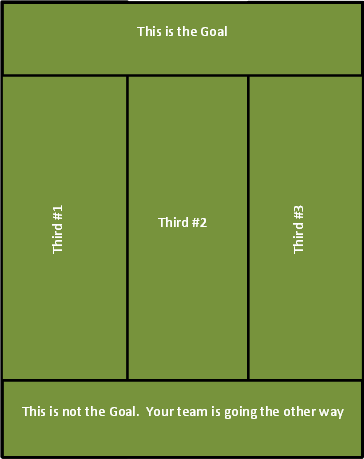
Same thirds is the only hucking rule I’ve ever heard of.  The concept is simple: take the field and divide it vertically into three thirds.  If you, your receiver, and the place you’re throwing too are all in the same third of the field then you did a bad job.  All other options are good.

Simple enough, however people seem to screw this up a lot.  Below is a field.  On a completely unrelated note, I often wonder why it is so difficult to grasp the orientation of the field.  I hope I’ve outlined it completely below, if not imagine yourself inside the map.


Common misunderstandings:
1.      The thrower and the place the disc was caught are in the same third, that’s bad.
a.       False, there are three pieces not two.
2.      The thrower and the receiver were in the same third, that’s bad.
a.       False, there are three pieces not two.
3.      The receiver and the place the disc was caught are in the same third, that’s bad.
a.       False, there are three pieces not two.

Below is the same image as above with some dot’s on it:


T = Thrower
R = Receiver
C = Where the disc is caught

As you can see one of the two is not in the same third, therefore good huck.  Any drawing where three dots are in more than one third is a good huck. 

Below is the same drawing with new dots.


The three dots are all in the same third, bad huck.  “But Bruns does the endzone count?”  Yes.  Yes it counts.  Obviously the lines that split the field extend into the endzone, are you kidding me?

Triangles:

So far I’ve outline the rule of thirds.  It’s easy, clear, extremely accurate, yet somehow incredibly difficult to grasp and apply quickly.  The main issue people have with this rule is that they forget there are three pieces, not just two.

This is where my thought comes in.  It’s the exact same as the rule of thirds, I just hope it’s easier to think about.  I call it hucking triangles.  The main advantage I see in the hucking triangle rule is that it is more dynamic, ignore the field and just look at the three pieces, what kind of triangle does it make? 

Below is an image of a field.  Again I hope it is clearly drawn.


Below is the same field with dots on it.
 

Again:
T = Thrower
R = Receiver
C = Where the disc is caught


Now, I’m about to do something crazy.  Please brace yourself.


I have drawn a triangle.  A good triangle is one that has large surface area, the more surface area on a triangle the better


This is a bad hucking triangle, due to how little surface area it covers.  Terrible!

The Limits:


Just as with the rule of thirds, hucking triangles have limits.  The most obvious is that silly cutters will believe that they should make their cut from R to C in the straight line that is drawn on the field.  This is absolutely and comprehensively wrong.  The cutter will not follow a straight line from dot to do, he will probably run down the field as he makes a read and curve into the disc.  The point of the triangle is to connect where we are starting to where we end and summarizing, not to tell us how to get from here to there.

Monday, March 2, 2015

Creativity

This is a post of questions and experiments, certainly no answers will be found here.

How do you build a creative player:

Creativity, awareness, and feel for the game.  This is my end goal of player development.  How can I fast track a player who can’t throw a flick to be comfortable with the speed and flow of a Frisbee game?

3v3:

My first idea, which I still haven’t given up on, was to reach a critical mass of 3v3.  During the fall NUT plays an hour of 3v3 three times a week.  We can get about 5 games of 3v3 done each hour.  By the end of fall quarter, given they show up to practice, NUT players have 30 hours/150 games of 3v3 under their belt.  I played 210 games of ultimate in my college career.  (A typical college ultimate player can expect to play ~50 games a year, ~7 games a tournament, 2 fall tournaments, 3 spring tournaments, 2 series tournaments).  My thought when deciding how to allocate fall practice time was how to manufacture as many game-like scenarios as possible.  With 3v3 you are forced to be involved, you have to play quick, you have to be a thrower, you have to be a cutter, and you have to play defense.

I thought this idea was simple enough to be brilliant until my boy Sahaj, my contemporary Kennedy, started questioning the value of 3v3.  It’s not actual ultimate, all people do is throw hucks, no one is trying on defense.  All good points by Sahaj, although my obsession with 3v3 is still high I cannot claim that it is the golden ticket to creativity.

Keep Away:

The first ideas we encounter are always the right and the best ones.  Or so we believe.  Ultimate is certainly no exception, play club for a season and the struggles of working with people “who were always taught to…” will make you want to battle them in the octagon.  So when you have players that have a narrow view of a game, and all they are doing is playing within that narrow view how do you shake their world and force them to see it differently?  My idea was change the rules.

In keep away you have a box, and all you have to do is complete passes.  Ignore the need to go downfield and gain yards, just completed passes at angles and distances you aren’t used too.  The plan was to give no instruction on keep away strategy, because I don’t have a strategy I believe in myself, and just let them figure one out on the fly.  Offensively do we just move the disc around the border like a big wheel?  Do we go back and forth diagonally?  Do we try to get the disc in a corner and attack the two adjacent corners?  Do we keep the disc in the middle of the box?  Defensively do we force one cone?  Do we force middle?  Force outside the box?  Try to set a trap?  Play zone?  If you can get your players asking these types of questions then they are displaying higher cognitive function.

So there I am patting myself on the back for changing the face of the game and forcing the team to think about it in a different way when Sahaj, that itch on my conscience, informs me that any 3 monkeys in the box and they’d win by throwing the disc up in the air.  Bummer that one.

Watching footage:

This is an idea that is bubbling but I don’t have in production mode.  I’ve been sending “pulled hammer” videos to all my sophomores, I can see that they’ve received the messages but then when I try to talk to them about it they can’t even remember what the video was about.  Most of these are just throwing form or handler give and go videos, about 7 minutes long that have fallen on poorly cultivated ears.

So where do I turn with this new idea?  I looked to none other than Sahaj, that little rapscallion of a dissenter.  I’ve given Sahaj a game with Bobby Ley and Justin Lin, both small handlers with fantastic throws and the ability to get open often.  I talked with Sahaj about these games and he had some thoughts and seemed to have actually owned the exercise.  The game is about 30 minutes, so maybe the longer film gave him more ideas; we also had just played both those teams at Warm-Up so maybe the taste of being beaten by them was still fresh for him.

The horizon:

I’m not sure where to go from here.  I can go with the “hope they learn during tournaments” or the “hope they play club ultimate” strategy.  In terms of creating a creative player myself, I think time is going to be the one variable that I cannot streamline.  If I want 15 game-breakers I am going to have to wait and I’m going to have to keep throwing them out of their comfort zones.


Friday, February 27, 2015

Sideline Talk

“Sideline Talk” is overvalued.

Talk + Listening = Communication:
Sideline talk requires two pieces.  Someone has to talk and someone has to listen.  Everyone is yelling at their sidelines to talk and every captain is urging their team to help the defense, but no one is yelling at the players on the field to listen.

Think about your typical handler defender, face guarding 10 yards from the disc.  The thrower zips one right past his head, a few guys on the sideline yell “up” a few yell his name.  Somehow in the 1-2 seconds that it took the disc to fly past his head he wasn’t able to process his name, find the disc, and swipe at it.  His reaction? Yell at the sideline to talk more.

Guy is guarding his man deep.  His guy starts busting deep 15 yards deep of the disc, makes a 40 yard cut straight away and catches it.  There were up calls, unfortunately no one said “right!” or “left!” and he couldn’t find the disc.  So after running next to a guy for 40 yards and never once taking a moment to think to himself, “I bet this could go up”, and never once thinking, “I should find the disc” this guy gets scored on turns to the sideline and yells “sideline!”

Yo bro we did talk, you weren’t listening.

Good Defense is Triangulating:
Good defenders are able to see the disc and their guy.  Great defenders are working hard to constantly maintain a position where they can see both.  One hip should be pointed at the disc and the other hip should be pointed at your guy.  You should be able to see the disc leave the throwers hands and go into your guys hands, or your hand.

We’ve got players staring straight at their guy when they are 30 yards from the disc.  Do you really need to be zeroed in on your guy when he is that far away?  Don’t you think you could see the disc and see if there are opportunities to help?  Obviously if he starts to move you’re going to have to move your attention back to him and the disc, but until he moves why isn’t your attention on the disc and the field?

I often think of Walden and Neal when I think of good defenders.  I’m pretty sure no one ever told them how to get their D’s, they were just paying attention to their surroundings and they could see the play before the sideline could.  That’s the thing, when you’re on the field you have a sense of the grain, the eb, the flow, and the pace of what’s going on.  Do you really want to just leave all those factors on the table and trust “some dude on the sideline’s perspective”?  Is his perspective superior to yours?  Who’s really in the better position to make defensive choices?

You should probably just pay attention yourself.

It takes time to process words:
There is a lot going on when you’re defending.  Is it really necessary to further complicate the system by trying to process what someone is saying?  In college during marking drills Austin used to tell me that you should start saying “no around” too early because there will be a delay in your teammates head, and by the time they realize they should be going no around it is actually time for them to go.

***Disclaimer:  I think “no around” calls are massively important and should be treated as an exception.***
So if the defender, in his infinite wisdom, decides to face guard and is capable of hearing the call from the sideline, does he even have enough time to process it or is he going to get beat anyway?  Is it worth relying on sideline talk?  Should we try to bank on something a little more real time?


But Bruns don’t you think you’re expecting too much of young players awareness and feel of the game?:
Sure.  Most of my guys are incapable of paying attention to the field.  They are so terrified of getting beat that they decide to just stare at their guy.  They haven’t played enough ultimate to anticipate what’s happening, or to understand where they are at any given moment.  Most of them are just trying to not make mistakes.  But as a coach it’s my responsibility to push them towards awareness of their world, not let them settle comfortably into one-dimensionality.  No one is going to get better with low expectations.

The above point is pretty weak.  The real counterpoint is my boy Jay.  Jay has played a few years of high school ultimate, can still barely throw a flick, by all accounts is a very raw Frisbee player, yet he makes plays on help defense, never needs me to tell him the disc is up, and recognizes when it’s time to try to make a play.  How come Jay, a boy who can’t throw is acutely aware of the realm of possibilities that throwers have?  Why is this?  I don’t know, obviously some guys progress and become comfortable with the game quicker than others.  Jay just learned to use his eyes sooner.


The current game plan is to agitate the roster until enough kids with awareness are left, and then give them inflated play time.

Wednesday, April 16, 2014

Regions


2:46 PM
Adam: gunna rain this weekend

me: yep
 
its gunna be awesome
2:47 PM
Adam: you know it

me: the epicness is going to be out of control

Adam: whys that?
2:48 PM
me: its the perfect setting
2:49 PM
Adam: rain?

me: yea
 
its going to be awesome
 
like
 
if we were to make a movie
 
it wud just be a montage of epic images
 
with the rain falling
2:50 PM
duel of the fates in the background

Adam: itd be like thunder storms with lightning would be the perfect setting
 
basically the end of the world

me: yea
 
exactly
 
thats what i want
 
just insane rain
 
and mud
 
and blood
 
and death
2:51 PM
Adam: yeah
 
thatd be great

me: http://www.youtube.com/watch?v=WuHImVS1u7A
 
im just going to listen to this
 
in my head
2:54 PM
Adam: yeah thats pretty accurate

me: i want locusts to descend upon the field
 
and angels to be battling demons in the sky
2:55 PM
Adam: seems likely
2:56 PM
me: dont shoot down my dreams
2:57 PM
Adam: im trying to find an accurate picture
3:02 PM
me: http://i.telegraph.co.uk/multimedia/archive/01725/thunderstorm-cloud_1725579i.jpg
 
thats what i want the warmup to feel like

Adam: lol

me: everyone knows the storm is coming
 
all you can do is prepare
3:05 PM
Adam: yuo
3:07 PM
me: http://www.youtube.com/watch?v=5EAzgAx0KHM&feature=related
3:08 PM
u might like that one
5 minutes
3:13 PM
Adam: maybe ill throw something together
3:14 PM
me: http://i293.photobucket.com/albums/mm79/God_of_Thunder_09/Epic/1222332767080.jpg
 
thats going down above the field

Adam: kinda like that
3:16 PM
me: o my
 
im getting lost in the internet
 
its too big

Adam: haha
3:17 PM
me: http://www.metacafe.com/watch/224588/naruto_vs_sasuke_the_ultimate_fight/
3:18 PM